


I have written this essay with AI — below are not my words… This below blog is just an template for demonstrating components of my website. I will write this blog in my words and thoughts someday when I get to it!
The Image That Won’t Leave
There’s a shot near the end of Into the Wild — Christopher McCandless alone in the Magic Bus, writing in his journal, sunlight filtering through filthy windows. He writes: “Happiness only real when shared.”
It’s the kind of line that should feel trite. It doesn’t. Sean Penn earns it through two hours of relentless visual storytelling, and that’s what I want to think about here: how the film uses its craft to make us feel the full weight of solitude.
Happiness only real when shared.
The Timeline of a Disappearance
McCandless’s journey is non-linear in the film. Penn intercuts the Alaska storyline with flashbacks to the road, creating a rhythm of accumulation and loss. Let’s map the key movements:
Chris graduates from Emory University with honors. He donates his $24,000 savings to Oxfam and vanishes.
Chris burns his cash, abandons his car, and adopts the name Alexander Supertramp. He drifts through the American West.
He meets a series of people — Jan and Rainey, Wayne Westerberg, Ron Franz — each offering a version of community he keeps refusing.
Chris hitchhikes to Alaska and walks into the wilderness with a .22 rifle, a bag of rice, and a few books.
Weakened by starvation and possibly poisoned by wild potato seeds, Chris dies alone in the abandoned Fairbanks City Transit bus.
Penn’s non-linear structure is not a gimmick. By showing us the connections Chris makes on the road while we already know he will die alone, every act of warmth becomes unbearable. The dramatic irony is structural, baked into the editing itself.
The Visual Philosophy
What makes Into the Wild a genuinely philosophical film — rather than a film about a person with philosophical ideas — is its visual language. Penn and cinematographer Éric Gautier make choices that encode ideas directly into the image.
The film’s wide shots of the American landscape are not decorative. They function as visual arguments about the relationship between the self and the world. When Chris is small in the frame, the landscape is presented as sublime — vast, indifferent, beautiful. When the camera is close, Chris is presented as radically free but radically alone.
The tension between these two scales — the cosmic and the intimate — is the film’s philosophical argument. Penn never resolves it. He holds both in suspension, which is why the ending lands so hard.
The Three Visual Modes
The McCandless Debate
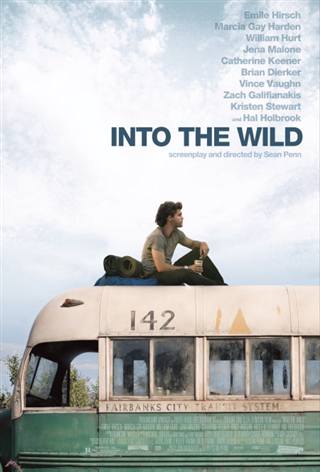
Sean Penn
9 /10Into the Wild
Sean Penn
2007
No discussion of this film is complete without acknowledging the controversy around the real Christopher McCandless. The debate is perennial and, frankly, predictable:
McCandless was a genuine seeker — someone who saw through the materialist consensus and chose authenticity over comfort. He made mistakes (fatal ones), but his project was noble. He belongs in the tradition of Thoreau, Muir, and Kerouac.
McCandless was an arrogant, underprepared college kid who romanticized poverty and wilderness. His death was preventable. Celebrating him encourages dangerous imitation. Alaskans, who deal with the actual wilderness, tend to be less impressed.
I think both views are partially right, which is what makes the film interesting. Penn doesn’t fully endorse or condemn Chris. He shows him — his charisma, his cruelty to his parents, his tenderness with strangers, his fatal stubbornness.
The film is not an instruction manual. It is a portrait. Confusing the two has led real people to die on the Stampede Trail trying to reach Bus 142.
The Emerson Problem
McCandless was a devoted reader of Emerson and Thoreau. The film shows him underlining passages, scribbling marginalia. But there’s an irony that neither Chris nor many viewers fully reckon with:
Society everywhere is in conspiracy against the manhood of every one of its members.
Emerson wrote this from his comfortable house in Concord, Massachusetts. Thoreau’s “wilderness” cabin at Walden Pond was a twenty-minute walk from town, and his mother did his laundry. The Transcendentalists theorized about self-reliance within a thick web of social support.
McCandless took the rhetoric literally. He enacted the metaphor. And the metaphor killed him.
Jon Krakauer initially attributed Chris’s death to eating toxic wild potato seeds (Hedysarum alpinum). Later research by Ronald Hamilton suggested the seeds contained a toxic amino acid (ODAP) that would cause lathyrism — a paralytic condition that prevented Chris from foraging. The cause of death remains debated, but the more important point is this: Chris was not undone by one mistake. He was undone by a cumulative series of small miscalculations, each individually survivable, that compounded into a death sentence. This is how the wilderness actually kills people.
The Musical Architecture
Eddie Vedder’s soundtrack deserves its own essay. For now, I’ll note one thing: the songs are not accompaniment. They function as a Greek chorus — commenting on the action, providing an emotional counterpoint that the stoic Chris himself cannot articulate.
The song “Guaranteed” plays over the final sequence. Its lyric — “On bended knee is no way to be free” — captures the paradox of the entire film: freedom pursued to its logical extreme becomes its opposite.
What the Film Knows That Chris Didn’t
The genius of Into the Wild is that it is smarter than its protagonist. The film knows that Chris is wrong — that isolation is not liberation, that the romantic myth of the self-sufficient individual is exactly that, a myth. But it also knows why Chris believed it, and it refuses to condescend.
Penn structures the film so that the audience falls in love with Chris’s freedom at exactly the same pace that the narrative machinery of his death tightens around him. By the time we realize the trap, we are already in it — just like Chris.
That’s not just good filmmaking. That’s a philosophical argument delivered through structure rather than dialogue. The medium is the message.
Into the Wild remains, for me, one of the most honest films about the American myth of individualism. It neither celebrates nor condemns. It witnesses. And in witnessing, it asks the hardest question of all:
What are you willing to give up to be free — and is the thing you give up the very thing that makes freedom meaningful?